
Beyond Behaviour: What Children's Emotions Are Really Asking Us to Notice
By Leigh Kennedy, Founder of Amdora Therapies
Beyond Behaviour: What Children's Emotions Are Really Asking Us to Notice
Author
By Leigh Kennedy, Counsellor, Artistic Therapies Practitioner & Professional Development Facilitator
Through my work as a counsellor, artistic therapies practitioner and professional development facilitator, I am continually inspired by educators' commitment to understanding and supporting children's emotional worlds. Many of the conversations I have with early childhood professionals centre around behaviour, yet beneath every behaviour there is often a deeper story waiting to be understood.
Beneath every behaviour is an experience, a feeling, a need, or a story that a child may not yet have the words to express.
What if, instead of asking "How do I manage this behaviour?", we became curious about what the behaviour might be communicating?
This article explores how emotional literacy, attachment-informed practice and artistic expression can help early childhood educators understand children's behaviour beyond surface actions. It explains why behaviour is a form of communication, how creative experiences support emotional regulation and wellbeing, and why developing educators' own emotional awareness strengthens relationships, resilience and learning in early childhood settings.
Looking Beyond the Behaviour - What Is Children's Behaviour Really Communicating?
Many children struggle to explain what is happening inside their emotional world. They may not yet have the language, self-awareness, or confidence to express complex emotions.
As educators, we often find ourselves supporting children who are:
Finding transitions difficult
Struggling with emotional regulation
Experiencing social challenges
Seeking connection and reassurance
Responding strongly to change
Finding it difficult to express their feelings with words
When we begin to view behaviour through a relational and developmental lens, our responses often shift from correction to curiosity.
Rather than asking:
"What's wrong with this child?"
We begin asking:
"What might this child be trying to tell me?"
Why Is Emotional Literacy Important in Early Childhood?
Emotional literacy is more than simply naming feelings.
It involves developing an awareness of emotions, recognising how feelings show up in the body, understanding emotional experiences and learning healthy ways to express them.
Children who develop emotional literacy are often better able to:
Recognise and communicate their feelings
Build positive relationships
Increase self-awareness
Develop resilience
Solve problems more effectively
Navigate social situations with greater confidence
These skills become important foundations for wellbeing, learning and school readiness.
How Does Artistic Expression Support Emotional Regulation?
Children do not always express themselves through conversation.
Sometimes they express themselves through movement.
Sometimes through play.
Sometimes through imagination.
And sometimes through artistic expression.
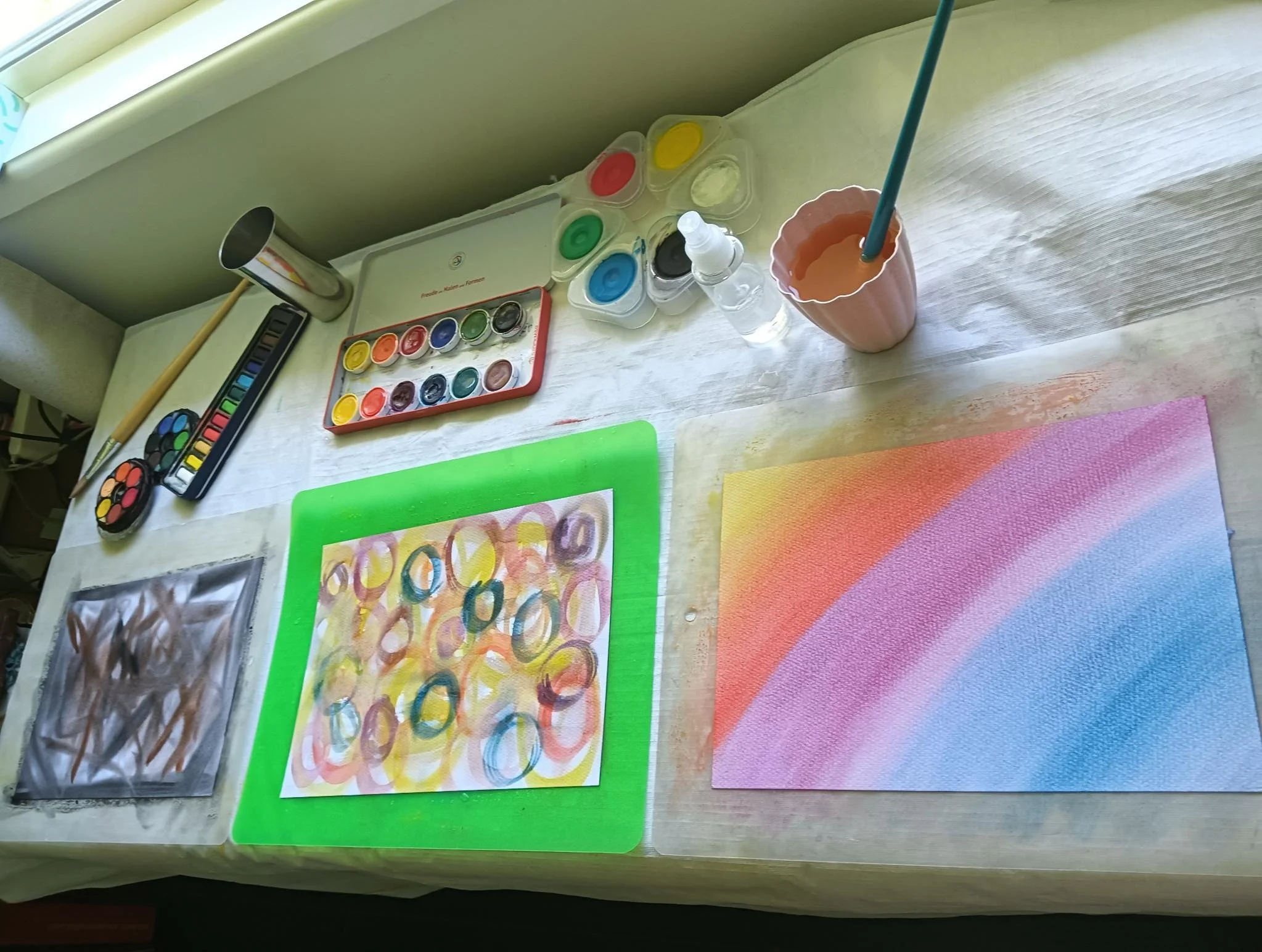
Creative processes can provide opportunities for children to explore feelings, ideas and experiences in ways that feel safe and accessible. Through colour, texture, symbols, storytelling and sensory experiences, children are often able to communicate aspects of their inner world that may otherwise remain hidden.
At Amdora Therapies, artistic processes are carefully facilitated using specific mediums and experiences designed to support emotional awareness and expression. Rather than focusing on behaviour alone, the creative process invites children to gently explore the emotions that may be sitting beneath the behaviour.
As emotions are recognised, expressed and understood, they often begin to lose some of their intensity, creating space for greater self-awareness, connection and emotional regulation. In many cases, when the emotional experience changes, the behaviour naturally begins to shift as well.
The focus is not on creating perfect artwork. The focus is on the process.
The process creates opportunities for children to:
Explore emotions
Develop self-awareness
Build emotional vocabulary
Strengthen confidence
Experience creativity without judgement
Develop healthy ways of expressing themselves
Increase emotional regulation
Strengthen connection to self and others
Through creative exploration, children can begin to understand their emotional experiences better, develop greater emotional literacy and build the foundations for wellbeing, resilience and healthy relationships.
What Educators Often Discover
One of the most unexpected outcomes of professional development in this area is that educators frequently gain insights into themselves as well as the children they support.
When exploring topics such as emotional literacy, attachment, relationships and wellbeing, participants often discover that understanding children's emotional worlds begins with understanding our own.
This is not about becoming therapists.
It is about developing greater awareness, empathy and confidence in responding to the children we work with every day.
Many educators describe this learning as both professionally enriching and personally meaningful.
Creating Environments Where Children Feel Safe, Seen and Supported
Children thrive when they feel:
Safe
Connected
Valued
Understood
Supported
When educators understand the emotional and relational factors influencing behaviour, they are often better equipped to create environments where children can develop a sense of belonging, confidence and emotional wellbeing.
The goal is not perfection.
The goal is connection.
And often, it is through connection that children find the safety to learn, grow and flourish.
A Final Reflection
Every child has a unique way of communicating their needs, emotions and experiences.
Sometimes those messages come through words.
Sometimes they come through behaviour.
And sometimes they emerge through creativity, imagination and play.
When we slow down, become curious and create opportunities for children to express themselves in diverse ways, we open the door to deeper understanding—of the child, of relationships and ultimately, of ourselves.
At Amdora Therapies, professional development for kindergartens, childcare centres and early learning services explores emotional literacy, emotional regulation, educator wellbeing, attachment-informed perspectives and artistic approaches that support children's wellbeing through practical, experiential learning.
About the Author
Leigh Kennedy is the founder of Amdora Therapies, a counsellor, artistic therapies practitioner and professional development facilitator working with kindergartens, childcare centres, educators, children and families.
She is the creator of Developing Emotional Awareness Through Artistic Expression, a professional development program that explores emotional literacy, emotional regulation, attachment-informed perspectives, and creative approaches that support children's well-being, educator growth, and relationship-based practice.
Through Amdora Therapies, Leigh provides experiential learning opportunities that help educators deepen self-awareness, strengthen emotional understanding and build their capacity to support children's emotional development and wellbeing.
Interested in Learning More?
Amdora Therapies provides professional development for kindergartens, childcare centres and early learning services exploring emotional literacy, emotional regulation, attachment-informed perspectives, educator wellbeing and artistic approaches to supporting child wellbeing.
Contact us to learn more about upcoming professional development opportunities.
Social and Emotional Capability in Kindergarten: Trauma-Aware Kindy Uplift Strategies
Why Social & Emotional Capability Matters More Than Ever
Author
By Leigh Kennedy, Counsellor, Artistic Therapies Practitioner & Professional Development Facilitator & Director of Amdora Therapies
Social & Emotional Capability is the heart of early learning. When children feel safe, connected and understood, everything else — language, play, executive function, behaviour — begins to flourish.
For Queensland Kindy teams working within the Kindy Uplift Priority Areas, this capability is not just important; it’s foundational. Directors and educators are increasingly seeking practical, trauma‑aware strategies to help children regulate, relate, and thrive.
This guide offers clear, gentle, real‑world practices you can use immediately in your Kindy environment.
What Is Social & Emotional Capability?
Social & Emotional Capability refers to a child’s ability to:
Understand and express emotions
Build relationships
Co‑regulate with adults
Manage frustration and transitions
Develop confidence and resilience
In trauma‑aware practice, we see these skills as relational, sensory, and developmental — not behavioural. Children learn them through connection, repetition and safety.
Why It’s a Kindy Uplift Priority Area
Queensland Kindy Uplift identifies Social & Emotional Capability as a key area that strengthens:
Classroom calm
Inclusion
Language development
Executive function
Educator confidence
Directors often search for PD that:
Supports emotional regulation
Helps educators understand behaviour
Provides sensory tools
Builds trauma‑aware practice
Offers practical strategies they can use immediately
Your Kindy program aligns directly with these needs.
The Trauma‑Aware Lens: Behaviour as Communication. Our bodies are a way of communicating before words are engaged. Think of a time when you walked into a room and felt uncomfortable, or someone looked at you glaring, compared to a warm smile!
Children communicate through behaviour long before they communicate through words. A trauma‑aware approach asks:
“What is this child trying to show me?” rather than “How do I stop this behaviour?”
This shift:
Reduces stress for educators
Builds relational safety
Supports inclusion
Strengthens emotional literacy
When educators understand behaviour as communication, they respond with clarity, connection and confidence.
Five Practical Strategies to Strengthen Social & Emotional Capability
1. Co‑Regulation as a Daily Practice
Children borrow our nervous systems. Simple co‑regulation tools include:
Soft voice and slow movements
Naming emotions gently (“Your body looks frustrated”)
Offering proximity without pressure
Predictable routines and transitions
These practices build emotional safety and reduce behavioural escalation.
2. Sensory Tools That Support Regulation
Sensory needs are often misunderstood as behaviour. Effective tools include:
Weighted items
Fidget objects
Movement breaks
Breath games
Quiet corners
These tools help children return to calm without shame or correction.
3. Rituals That Build Belonging
Rituals create predictable emotional anchors. Examples:
Morning welcome ritual
Group breathing
Story‑based transitions
Gratitude circle
Rituals strengthen connection, reduce anxiety and support executive function.
4. Emotion Naming & Modelling
Children learn emotional literacy through adult modelling. Try:
Naming your own feelings
Using simple emotion words
Linking emotions to body sensations
Offering choices (“Would you like space or a cuddle chair?”)
This builds language, confidence and self‑awareness.
5. Connection Before Correction
When children feel seen, they can learn. Connection‑first responses include:
Kneeling to their level
Gentle tone
Acknowledging their experience
Offering co‑regulation before redirection
This approach reduces stress and strengthens relational trust.
How This Supports Kindy Uplift Outcomes
Your educators will see improvements in:
Emotional regulation
Peer relationships
Classroom calm
Inclusion
Language development
Executive function
Educator confidence
These outcomes align directly with the Kindy Uplift Priority Areas and support your centre’s PD goals.
How Amdora Therapies Supports Your Kindy Team
Your Kindy PD program offers:
Trauma‑aware, relational training
Practical tools educators can use immediately
Sensory and emotional regulation strategies
Behaviour‑as‑communication frameworks
Delivery at your Kindy
Alignment with all four Kindy Uplift domains
Internal link prompts:
Link “Kindy PD program” → www.amdoratherapies.com/training
Link “trauma‑aware practice” → https://www.amdoratherapies.com/pbsp
Link “book a PD session” → https://www.amdoratherapies.com/contact
Conclusion: Building Emotionally Wise Kindy Communities
Social & Emotional Capability is not a skill children learn alone — it is a relational, sensory and developmental journey. When educators feel confident, calm and supported, children flourish.
Your trauma‑aware, emotionally attuned Kindy PD helps teams create classrooms where every child feels safe, seen and capable.